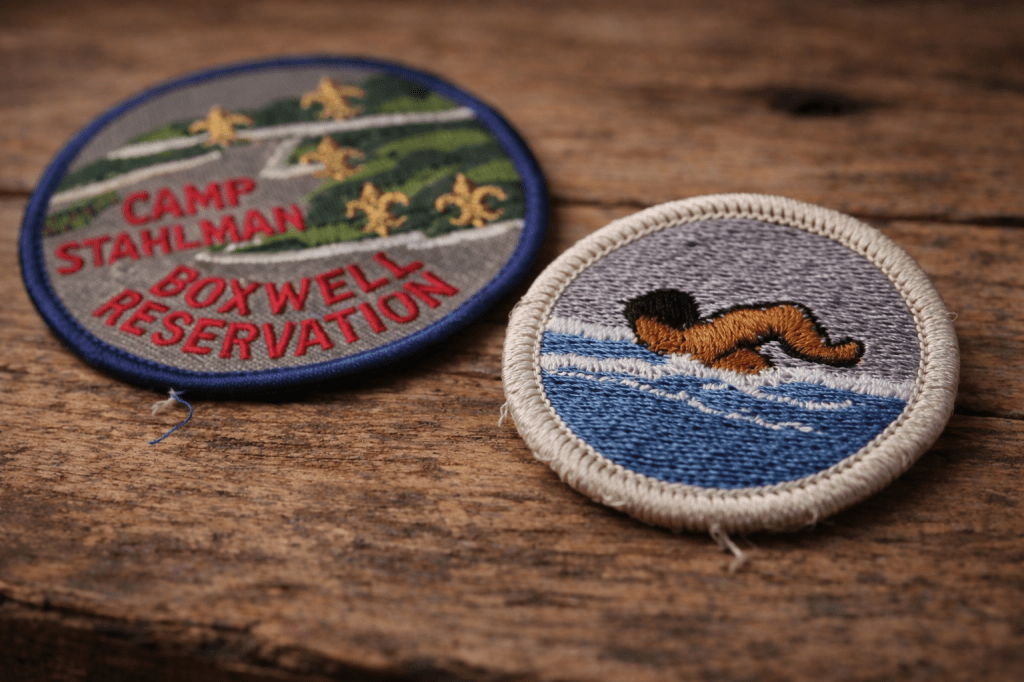
I spent several summers of my childhood at Boxwell Reservation, deep in the Tennessee woods, far enough from home that it felt like its own contained world.
This was the late 1990s. Cell phones were uncommon then, and they were certainly not something kids carried. There was no texting home, no checking in, no quiet reassurance from a glowing screen. Once you were dropped off, you were simply there for the week. Whatever you needed to handle, you handled it where you stood.
It was the first place I ever spent a full week away from my parents. No quick exits. No easy outs. Just canvas tents stretched over wooden planks, metal cots, and whatever sense of independence you brought with you into the woods.
At night, the woods felt bigger. I was part of the Beaver Patrol, and each patrol had its own small clearing with a bonfire ring in the center and tents set up around it in a loose circle. From our spot, you could hear other patrols in the distance. Laughter drifting through the trees. Someone tending a fire. The occasional shout carrying farther than it should in the dark.
I was the Assistant Patrol Leader that year, which mostly meant responsibility without much authority. Enough leadership to feel accountable, not enough experience to feel confident. When a storm rolled in, the fires went dark one by one, and the woods settled into a different kind of quiet. Inside the tent, my tentmate Brandon and I lay on our cots listening to rain hammer the canvas and thunder crack close enough to shake the poles. I do not remember seeing his eyes closed, and I know mine were not. Needless to say, there was not much sleep that night.
Each summer, everyone had to take a swim test to determine where they were allowed to swim. You were marked by color. If you passed, you could swim farther out. If you did not, you stayed in the shallows.
The test was simple and serious at the same time. Swim trunks on first. Jeans pulled over them. Jump into the water fully clothed. While treading water, take the jeans off, tie the legs together, trap air inside them, and turn them into a flotation device by sealing the waistband.
It was awkward. It was practical. And it felt enormous when you were a kid.
The first year, I passed easily. I was small, light, and comfortable in the water. I followed the instructions and climbed out without much thought.
The second year was harder. I was heavier. The jeans dragged more. My breathing was less steady. I remember my arms burning as I worked through it, but I passed.
By the third year, I assumed it would be the same.
But my body had changed in ways I did not fully understand yet. I had gone through an awkward growth spurt. Taller. Heavier. My strength had not caught up to my frame.
In the water, the difference was immediate. The jeans pulled me down faster than I expected. My movements felt inefficient. I could not trap enough air to stabilize myself.
I failed the test.
I was reassigned to the shallows with younger scouts. Publicly. Quietly. No commentary, just a different boundary line in the water and a color marking that told the truth.
It was humiliating in the way only childhood embarrassment can be. I wanted to disappear. I remember standing there pretending it did not matter, while it mattered deeply.
I had not earned the swimming merit badge yet. That was the reality I had to sit with. Not because I lacked effort or desire, but because I was not ready.
The following year, I came back again.
Nothing dramatic had changed overnight. But my muscles had finally caught up to my frame. My movements in the water felt controlled again. When I took the test that year, I passed cleanly.
That was the year I earned the swimming merit badge.
Not early. Not easily. Not because I forced it.
Because readiness finally met effort.
I finished as a First Class Scout. I earned the patches. Eventually, I earned the badge too.
But that is not what stayed with me.
What stayed with me was learning patience in a place where impatience did not work. You could not rush your body. You could not argue with the water. You could not borrow strength you did not yet have. You either stayed in the shallows, or you failed again.
Being part of a patrol mattered more than I understood at the time. The structure forced you to move at the pace of the group, not just your own. As Assistant Patrol Leader, I was responsible for others before I felt fully responsible for myself. I learned quickly that not everyone operated at the same level, and that leadership was not about pulling people forward faster. It was about noticing when someone needed help, or space, or time.
Patience has never come naturally to me. Professionally, it has probably been my greatest weakness. I see patterns quickly. I move fast. I expect alignment sooner than it sometimes arrives. Experience has tempered that instinct over the years.
What those summers taught me early was this. Sometimes people are not failing. They are growing unevenly. Sometimes strength lags confidence. Sometimes confidence lags strength. And sometimes the most important thing a leader can do is stand nearby and wait without judgment.
Earning that swimming merit badge did not matter because it was hard. It mattered because I earned it when my body, my effort, and my patience finally aligned.
Leadership works the same way.
We all have seasons where we are ready to swim farther, and seasons where we need the shallows. The measure of leadership is not how quickly you move ahead, but whether you remember what it felt like to wait.
I do not remember most of the badges.
I remember the storm.
I remember the quiet of the woods at night.
And I remember learning that patience, practiced early, becomes empathy later.
That lesson stayed.
 MyTNLife.blog
Leave a comment